LLC Formation
Business Address vs Registered Agent Address for an LLC
Business address vs registered agent address: these terms describe different functions. A registered office receives designated legal notices. A business may separately need a mailing address and an address showing where work actually happens.
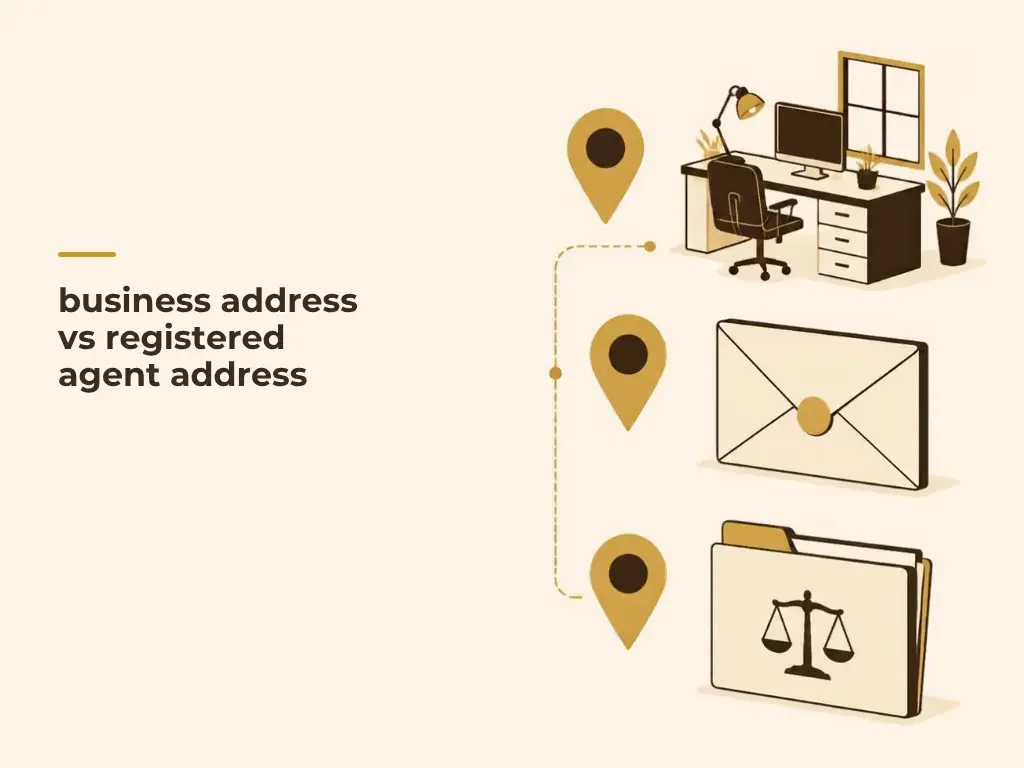
Business address vs registered agent address: these terms describe different functions. A registered office receives designated legal notices. A business may separately need a mailing address and an address showing where work actually happens.
Using one address everywhere can create problems when it answers the wrong question. International founders should map their addresses before applying for an EIN, bank account or payment service.
Business address vs registered agent address: a practical comparison

| Address type | Main purpose | Evidence to keep |
|---|---|---|
| Registered office | Delivery of legal process under state rules | Agent appointment and permitted-use terms |
| Mailing address | Receiving correspondence | Mail service agreement and forwarding instructions |
| Principal business location | Identifying actual operations | Genuine lease, utility record or other accepted evidence |
| Owner residential address | Verifying the individual | Provider-approved personal address evidence |
The exact labels vary across forms. Read the question attached to the field rather than assuming “US address” always means the same thing.
Start with the actual operating facts
Write down where you manage the company, perform services, hold inventory and employ people. An overseas founder working from home should not describe a mail forwarding location as a staffed office.
Next, list the addresses you are authorized to use. Confirm whether your agent allows its address only for the registered-office field or also for ordinary company mail. An address advertised on a provider's website is not permission to use it in your filing.
For a company with several locations, keep a short explanation of each. This makes later bank questions easier to answer consistently.
Match the address to the form
Form SS-4 distinguishes the mailing address from a street address when different. Its instructions also address foreign locations. Use the IRS SS-4 instructions and the facts of your company, rather than substituting a US mailbox simply because the entity was formed in America.
State formation forms have their own rules. The Florida LLC instructions distinguish the principal office, mailing address and registered office. A field that accepts a mailing address does not change the separate registered-office requirement.
Banking policies are another layer. Mercury currently permits a US or international principal business address, including a residential address, but excludes registered agent addresses, PO boxes and UPS Store addresses for that purpose. It also reviews country, business activity and US operations. See its current eligibility page.
A realistic international-founder example
Suppose an LLC is formed in Wyoming, its founder works from a home office abroad, and it buys a US mail service.
The company could have three legitimate address records: a Wyoming registered office, a correspondence address and the overseas operating location. Whether each is acceptable depends on the particular filing or provider. The example does not establish bank eligibility or a tax result.
When an application asks why the locations differ, explain the roles. Do not alter documents to make every address match. Consistent meaning matters more than identical text.
Check privacy before filing
Some state business records are public. Review which fields become public before entering personal information, and use only lawful alternatives permitted for those fields. A commercial address may reduce some public exposure, but it does not remove bank identification or government disclosure requirements.
Ask a provider four questions: what mail it accepts, whether it supplies usable address evidence, which uses are permitted, and what happens when the subscription ends. Save the answers with the contract.
Keep an address-change checklist
When you move, assess the state record, IRS record, agent account, bank, payment providers, insurers and invoices separately. Updating one does not update all the others. The IRS uses Form 8822-B for business address and responsible-party changes.
PrimeRegister can help you clarify the address support included in a formation package. Contact the team before purchasing an additional address service, especially if your main objective is a specific bank application.