
Annual Compliance
Do You Have to Renew Your LLC Every Year?
Learn what LLC renewal actually means and how to separate state filings, agent subscriptions, tax work and licenses.
Do you have to renew your LLC every year? Usually, you must maintain it each year, but the required task is not always called a renewal or annual report. Some states require an information report, some charge an annual tax or registration fee, and some use a different reporting cycle.
You normally do not form the same LLC again every year. Instead, you maintain the existing entity and complete the obligations that apply to its states, tax classification and business activities.
Checked 7 October 2026. Examples below illustrate different systems; they are not a complete 50-state compliance calendar.
Do you have to renew your LLC every year in every state?
There is no single US-wide LLC renewal form. Start with your formation state, then add every state where the LLC is registered to do business. Check tax and licensing duties separately.
The following examples show why a generic “annual renewal” reminder is not enough:
| State | Example of recurring LLC maintenance | What to avoid assuming |
|---|---|---|
| New Jersey | Annual report with a $75 base fee | The report completes tax returns |
| Virginia | $50 annual registration fee | An LLC must file the corporation's annual report |
| Delaware | Current $400 annual LLC tax, generally due June 1 | No annual report means no annual state payment |
| California | Statement of Information every two years after the initial filing, plus separate tax obligations | A biennial information report means there is no annual tax |
Sources: New Jersey fees, Virginia annual fees, Delaware LLC tax instructions and California LLC statement instructions.
These amounts are individual government charges, not a total operating budget. They exclude private services, other taxes and any late charges. Check the applicable record before making payment.
Five different things people call an LLC renewal
1. A state information report
This updates the public business record. The agency may ask about addresses, management and the registered agent. The filing is not usually a financial statement showing every sale and expense.
Check the actual reporting period. An annual report named for a particular year may have a deadline that differs from your federal income tax return.
2. An annual state fee or tax
Some states require a recurring payment even where an ordinary LLC annual report is not required. Do not dismiss a payment notice because a guide says your state has “no annual report.”
California illustrates the need to separate these questions. Many LLCs registered or doing business there face an $800 annual tax, subject to the applicable rules and exceptions. Their information statement follows a different schedule. California Franchise Tax Board LLC guidance.
3. A private registered agent subscription
The state obligation to maintain a qualifying agent and the price of a commercial agent service are related but different. A provider's renewal invoice is a private bill. Read whether it includes filing assistance or only registered agent service.
Changing providers also needs coordination. Avoid a gap between canceling the old service and establishing the new agent on the state record.
4. Tax returns and information reporting
Federal tax requirements depend on classification, ownership and transactions. A state payment does not automatically satisfy them. International ownership can introduce information-reporting questions even when a founder expects little or no US income tax.
For example, a foreign-owned US disregarded entity may have Form 5472 and pro forma Form 1120 obligations involving reportable transactions. Review the IRS Form 5472 instructions with a preparer who understands the actual business.
5. Licenses, permits and operating subscriptions
A local license, sales tax permit, software account and company registration all serve different purposes. Some renew; others remain active until closed or changed. Put them on separate lines so a single “renewal package” does not hide what still needs attention.
Build a calendar around your company
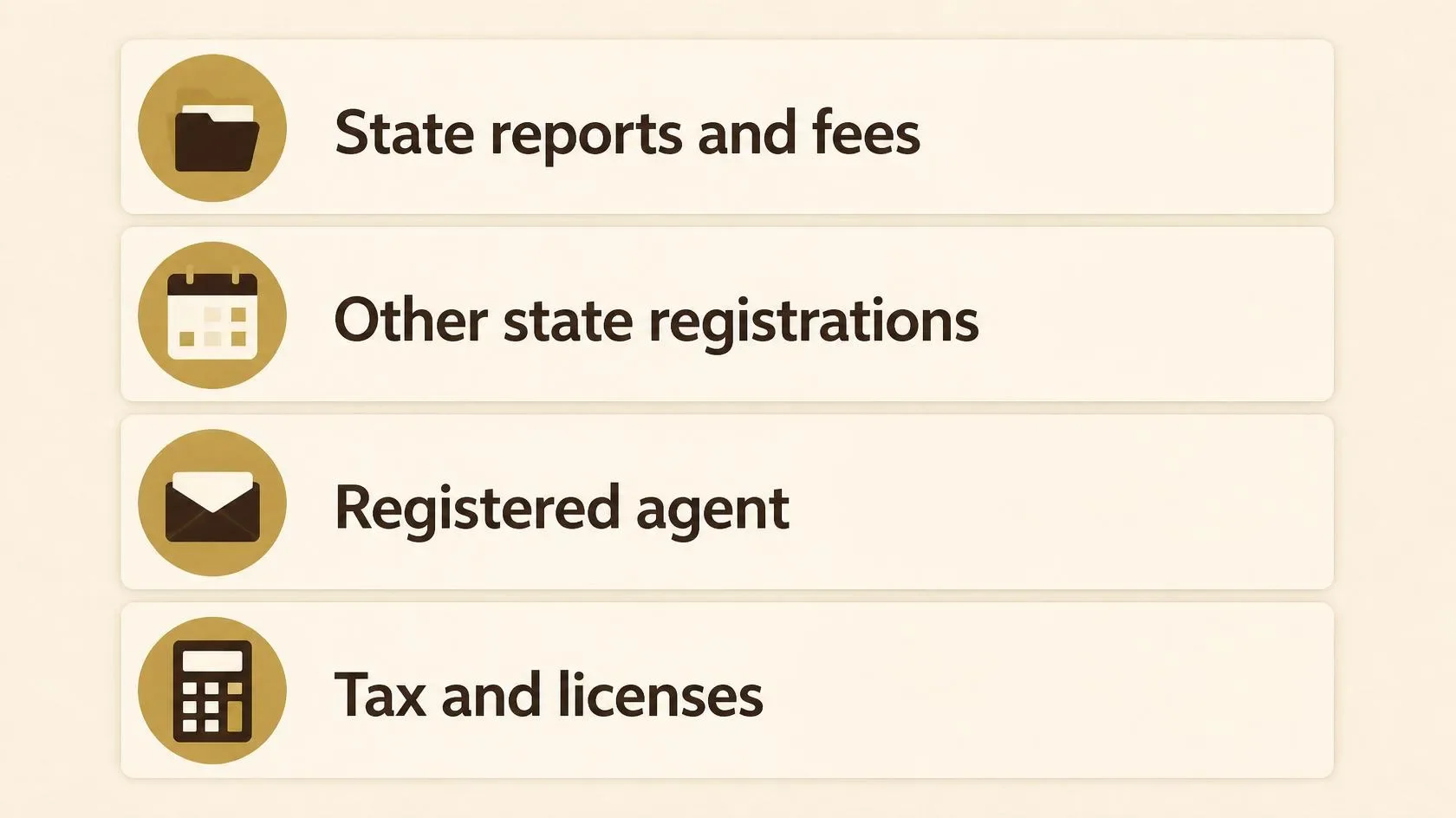
Start with a one-page inventory. For each jurisdiction or agency, record the entity or account number, required action, due-date rule and person responsible. Keep sensitive credentials in a secure password manager, not in the calendar itself.
Use a structure like this:
| Calendar entry | Information to record |
|---|---|
| Formation-state maintenance | Exact report or payment name and deadline |
| Additional state registrations | Each state's separate requirement |
| Federal tax work | Preparer, document deadline and applicable return deadline |
| State tax accounts | Filing frequency and whether zero returns are required |
| Registered agent | Contract renewal date and contact details |
| Licenses | Issuing authority and renewal terms |
Schedule a preparation reminder several weeks before each government deadline. That allows time to gather records or correct an access problem without treating the due date as the starting date.
What if the LLC had no income?
Separate “no revenue,” “no transactions” and “formally closed.” A founder may have no customers but still contribute capital, pay startup expenses or receive a distribution. Those facts can matter for tax reporting.
State registration obligations may continue while the entity exists or remains authorized. Do not use a zero bank balance as proof that the annual state fee disappeared.
If you want to stop maintaining the company, decide whether to close it formally. Gather the state records, ownership approvals, liabilities and tax history first. A considered closure is easier to document than years of ignored notices.
How much should you budget each year?
Use actual obligations rather than a nationwide average. Add government maintenance charges, registered agent service, tax preparation and activity-specific licenses. Include additional states only where the business has a relevant registration or obligation.
When comparing providers, ask whether the quoted amount includes government fees, report submission, tax preparation and any address service. A lower headline price may simply cover fewer tasks.
Save receipts by task. “Paid the annual package” is less useful during a review than “state report accepted, agent active, tax return submitted.”
A practical next step
Make your state and agency list before purchasing a renewal service. Then contact PrimeRegister to discuss the assistance available for your company.
Share the formation state, any additional registrations and whether the LLC has started operating. That gives us a useful starting point for identifying the work and explaining the scope of a quote.