
Business Expansion
Foreign Qualification vs Foreign-Owned LLC: Key Differences
Understand why an LLC can be domestic in its formation state, foreign in another state and owned by a founder overseas.
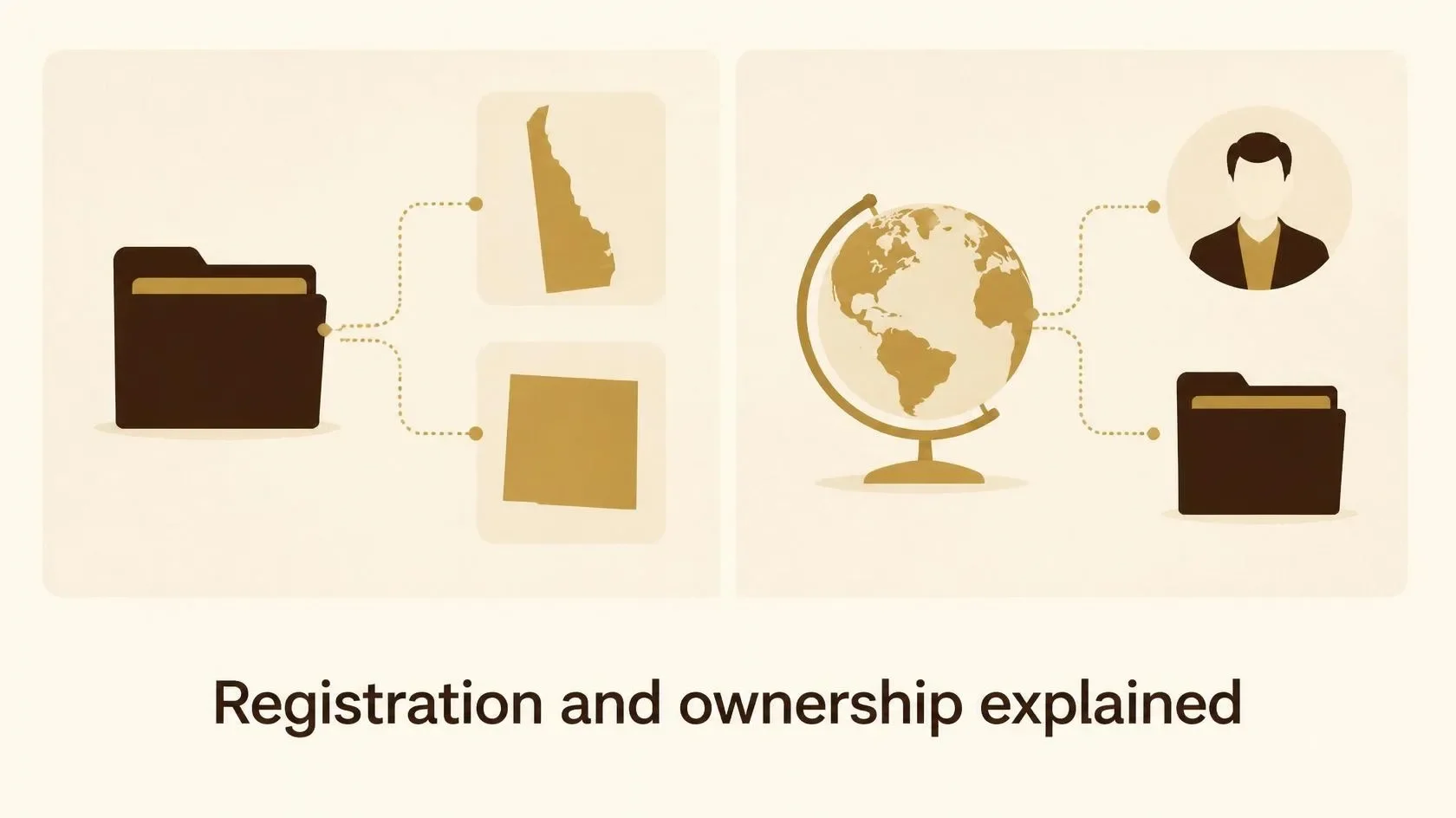
Foreign qualification and foreign ownership describe different things. Foreign qualification concerns where a company was formed and where it needs authority to do business. Foreign ownership concerns who owns the company.
A US LLC can be owned by a founder living overseas and still be a domestic LLC in its formation state. The same LLC may be a foreign LLC in another US state. Understanding these terms helps you choose the right state application and avoid confusing it with federal tax reporting.
Checked 7 October 2026. This guide explains the terminology; whether a particular business must qualify requires a review of its activities and the destination state's rules.
Foreign qualification vs foreign ownership
| Question | Foreign qualification | Foreign ownership |
|---|---|---|
| What does it examine? | The entity's place of formation and activities in another jurisdiction | The identity and status of its owners |
| Typical state issue | Authority for an existing entity to transact business | Correct owner or manager information where requested |
| Does it create another LLC? | Ordinarily, it registers the existing entity | Ownership alone does not create another entity |
| Does it determine federal tax treatment? | Not by itself | Ownership can affect reporting, alongside classification and transactions |
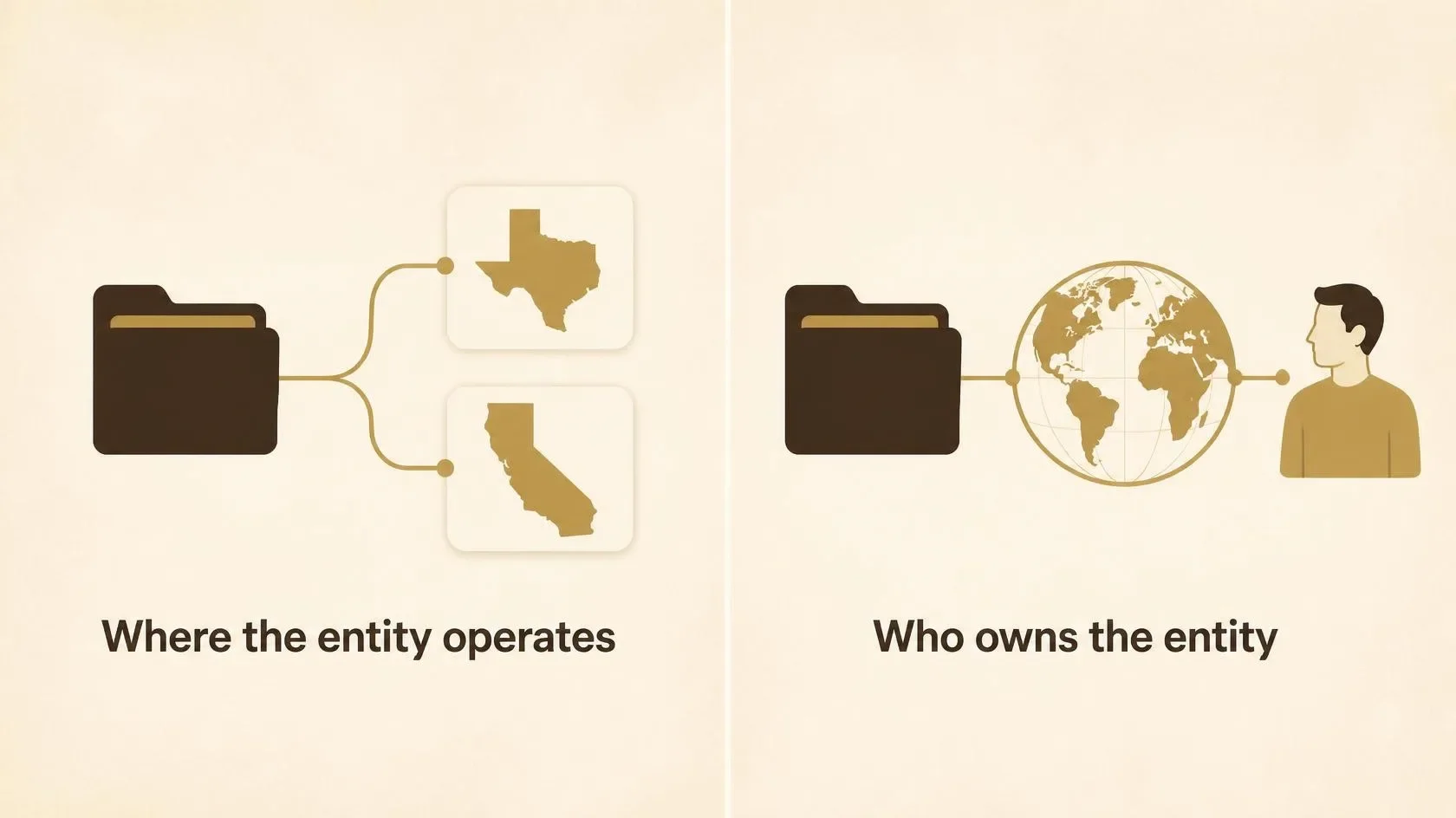
For state registration purposes, “foreign” can mean another US state. It does not necessarily mean another country. The North Carolina Secretary of State's foreign-business guide illustrates this use of the term.
Three examples for international founders
A founder abroad forms a Wyoming LLC
The LLC is formed under Wyoming law. It is a domestic Wyoming entity even if its owner lives in India, the United Kingdom or the United Arab Emirates.
The owner's overseas location does not, by itself, mean the LLC should submit Wyoming's foreign-registration application. It may raise separate tax questions, but those questions do not change where the entity was created.
A Delaware LLC opens a Florida office
The company remains the Delaware LLC. It should assess whether its Florida activities require registration there as a foreign LLC. Florida's foreign LLC application is an application for an existing entity formed elsewhere.
If registration is required, the business can acquire obligations in both states. That is different from forming a second LLC and moving contracts or assets to it.
A company formed outside the US enters a US state
This is a different structure again. The applicant is a company formed under another country's law, not a newly created US subsidiary. Its eligibility, documents and tax consequences need a separate review.
Do not assume that every non-US company is legally an LLC or should use an LLC application. Match the entity type to the destination state's process and obtain advice where the classification is unclear.
When should you review foreign qualification?
Review the issue before opening an office, hiring people in a new state or establishing ongoing operations there. Inventory, property, contracts and the nature of repeated local activity may also be relevant.
A customer's billing address alone is not a complete decision rule. Neither is the fact that your website accepts orders nationwide. States define the activities that require registration and the activities excluded from that definition.
For example, Florida's statute lists activities that do not, by themselves, constitute transacting business for qualification purposes. The list must be read with its scope and the actual facts. It is not a universal exemption from tax or other laws. Florida Statutes, section 605.0905.
Prepare a factual summary before asking for advice: where people work, where property is located, what contracts require and when the activities began. That is more useful than simply asking whether an “online business” needs registration.
Qualification, tax nexus and licenses are separate checks
A state may have different tests for company registration, income or franchise tax, sales tax and employment obligations. Passing one test does not answer the others.
California, for example, publishes its own tax guidance on doing business in California. A company should not assume that avoiding a Secretary of State filing removes a tax obligation arising from its actual activities.
Likewise, a registration certificate does not replace a professional license or authorize every regulated activity. Describe what your business actually does when checking permit requirements.
What the registration process usually involves
The details vary, but a useful preparation sequence is:
- Confirm the entity type, home jurisdiction and current status.
- Review whether the destination state requires qualification for the planned activities.
- Check the name and any alternate-name requirement.
- Arrange a registered agent meeting the destination state's rules.
- Obtain the required home-jurisdiction certificate within the accepted age limit.
- Submit the correct application and government fee.
- Record the new state's ongoing filings and tax-registration questions.
Do not order certificates too early without checking their validity window. For example, a document acceptable in one state may be too old for another. Also keep the original formation record: registering elsewhere does not replace it.
Does foreign qualification require a new EIN?
Registration of the same entity in an additional state is not the same as creating a new business. Do not request another EIN merely because a state application calls your LLC “foreign.”
Structural changes can produce different results. If you are creating a separate subsidiary, changing ownership or reorganizing the business, review the IRS guidance on when a new EIN is needed. Keep the EIN question separate from the state registration number assigned by the new jurisdiction.
What about foreign-owner tax reporting and BOI?
Foreign-owner federal tax reporting uses its own definitions. A foreign-owned US disregarded entity may have Form 5472 obligations involving reportable transactions. State qualification does not satisfy that filing. IRS Form 5472 instructions.
Beneficial ownership information reporting is another separate system. Under FinCEN's current rules, entities created in the United States are exempt from BOI reporting. Certain entities created outside the US and registered to do business in the US may still fall within the reporting rules. Foreign ownership alone does not turn a US-created LLC into that category. FinCEN BOI guidance.
Because these systems use similar words, write down the legal entity's formation jurisdiction before applying any rule.
Prepare the facts before choosing a filing
Contact PrimeRegister with the entity's formation jurisdiction, legal type and proposed US activities. We can discuss available assistance and confirm its scope.
If the qualification decision needs legal or tax analysis, resolve that before buying a filing. The goal is to submit the right application for the existing business and understand the obligations that follow.