Tax & Compliance
Form 5472 and Pro Forma 1120 for Foreign-Owned LLCs
A focused guide to the reporting workflow for foreign-owned US disregarded LLCs, including why no revenue does not always mean no filing.
A foreign-owned US single-member LLC can have a Form 5472 filing requirement even when it has no customer revenue. If it is treated as a disregarded entity and has reportable transactions with a related party, the filing generally involves Form 5472 attached to a pro forma Form 1120.
The starting question is not just “Did the business make a profit?” It is “What is the entity's tax classification, who owns it, and what transactions occurred?”
Checked 5 October 2026. This educational guide focuses on a wholly foreign-owned US disregarded entity. It is not a completed return or an individual filing determination.
Which LLCs does this Form 5472 guide cover?
Consider a US state LLC with one foreign owner that has not elected to be taxed as a corporation. That is the common situation addressed here. Form 5472 also applies to other reporting corporations in defined circumstances, but their filing workflow is not necessarily the special disregarded-entity workflow.
Do not automatically use this guide for a multi-member LLC, an LLC with a corporate election or a company formed outside the United States. Establish classification and ownership first. The IRS LLC overview explains the basic default classifications.
“Foreign owner” is a tax concept. A person's passport alone does not settle their US tax residency. If ownership changed or you are unsure of the owner's status, include those facts in the review.
Why no revenue does not always mean no filing
Reportable transactions for foreign-owned US disregarded entities can include contributions, distributions and amounts connected with formation or dissolution. Related-party payments and loans also deserve review. The IRS's Form 5472 instructions explain the applicable categories and exceptions.
Imagine a founder creates an LLC, contributes $1,500 and pays a formation invoice personally. The company has not yet sold anything. Those facts still need to be evaluated; a blank sales report does not describe the whole year's activity.
Use the following as a records checklist, not a ruling that every entry belongs on the same line:
| Event to identify | Evidence to keep |
|---|---|
| Owner funds the business | Bank record, date, amount and contribution or loan documentation |
| Owner pays a company expense | Invoice, payment evidence and accounting treatment |
| Company transfers money to the owner | Transfer record and explanation of the transaction |
| Company deals with a related business | Contract, invoices, amounts and relationship details |
| Company closes or distributes remaining assets | Closing records, transfers and final account balances |
What is a pro forma Form 1120?
A pro forma Form 1120 is the limited Form 1120 submission used to accompany the required information return in this situation. Filing it for this purpose does not itself elect corporate tax treatment.
For a foreign-owned US disregarded entity, IRS instructions require the entity's name and address and items B and E on the first page: the EIN and applicable initial-return, final-return, name-change or address-change boxes. Write “Foreign-owned U.S. DE” across the top. This is not an instruction to invent a full corporate income statement or enter zeros throughout an ordinary corporation return. Follow the special rule in the Form 5472 instructions.
The owner may have separate tax obligations. The pro forma filing should not be mistaken for a conclusion that all returns for every person are complete.
Information to organize before preparation
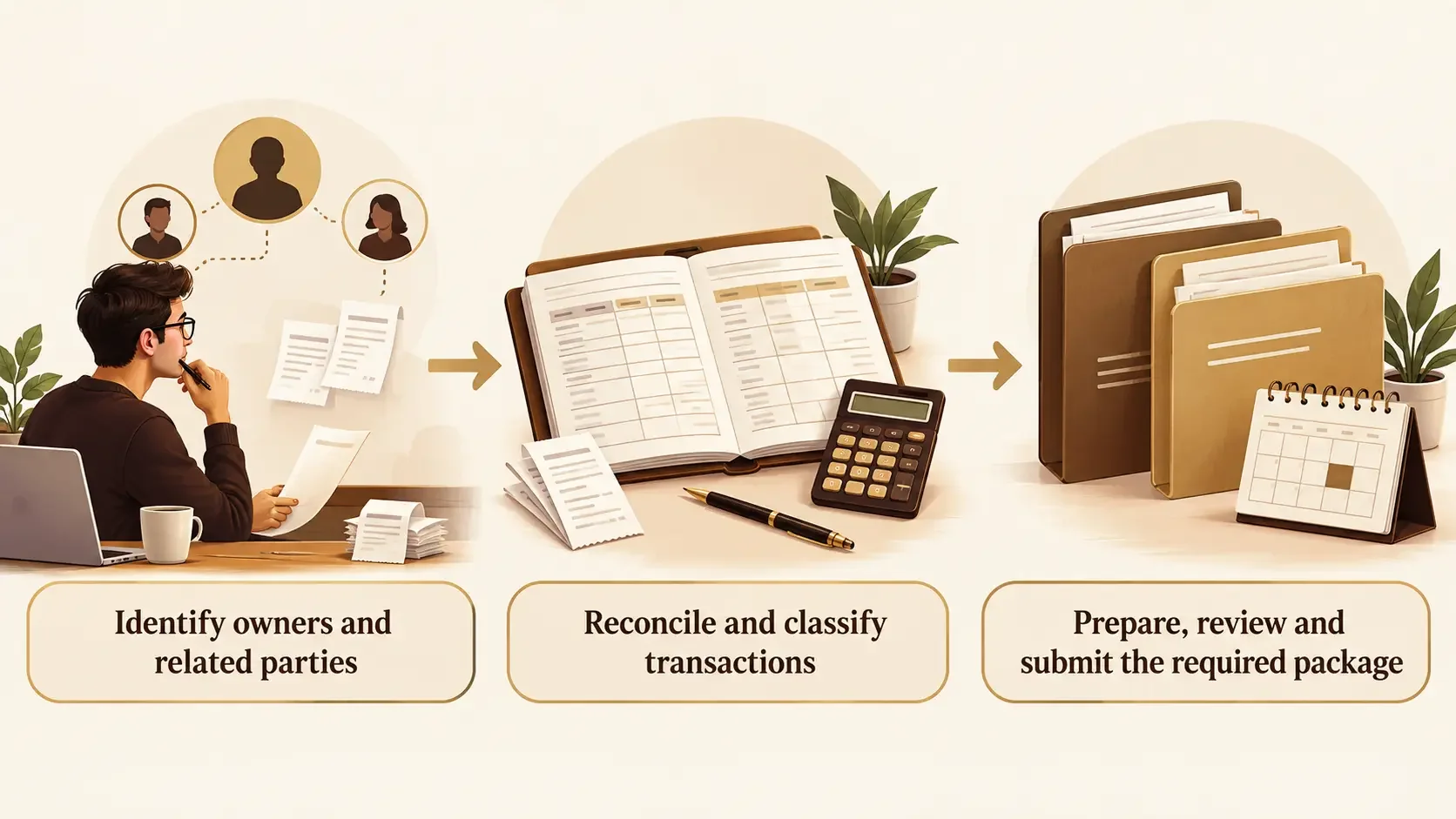
Build a file with the formation record, EIN confirmation, ownership details, owner addresses and tax identification information where required. Include the accounting year, bank statements, a reconciled transaction ledger and supporting invoices.
Identify each related party separately. A relationship can matter even when the party uses a different business name or bank account. Provide your preparer with the underlying ownership facts rather than only a list of transfers labelled “miscellaneous.”
The official Form 5472 separates reporting-entity information, ownership, related-party information and transaction disclosures. Preparing those categories in advance is more reliable than trying to reconstruct them while filling in the form.
For transactions in multiple currencies, retain the original currency amounts and document the conversion method used for reporting. Ask the preparer what records they need and use a consistent, supportable method.
How many Forms 5472 might be needed?
Generally, a separate Form 5472 is required for each related party with which the reporting entity had reportable transactions. The number of bank accounts or transfers does not determine the number of forms.
For example, transactions with the sole owner and with another related company should be reviewed as two relationships. Do not merge them simply because the owner controls both. Conversely, many transfers involving one related party do not necessarily mean one form per transfer.
When is the filing due?
The special package follows the applicable Form 1120 deadline. For a calendar-year entity, that is generally April 15 of the following year, subject to weekend, holiday and applicable relief rules. Under the current rules, a normal calendar year ending December 31, 2026 would generally have an April 15, 2027 original deadline. Confirm the entity's actual tax year and any later changes. IRS Form 1120 filing deadlines.
The disregarded entity generally uses the owner's US tax year or, if the owner has none, the calendar year. Short periods, ownership changes and closure deserve specific review.
Keep federal filing dates separate from the state's anniversary report or annual-tax date. Paying Delaware's LLC tax in June, for example, does not satisfy an IRS filing due in April.
Can you request an extension?
A qualifying entity can request additional filing time using Form 7004 by the original due date. For the special disregarded-entity package, use the Form 1120 return code, the required foreign-owned notation and the special submission route specified by the IRS.
The ordinary extension is generally six months, but an extension of filing time is not an extension of time to pay any tax that is otherwise due. It also does not retroactively repair a missed original deadline. Form 7004 instructions.
How is the package submitted?
Foreign-owned US disregarded entities cannot electronically file Form 5472 under the current special instructions. They use the dedicated fax or mailing route, rather than an ordinary Form 1120 mailing address.
As checked on 5 October 2026, the instructions specify fax 855-887-7737 at 300 DPI or higher, or mail to:
Internal Revenue Service
1973 Rulon White Blvd
M/S 6112 Attn: PIN Unit
Ogden, UT 84201
Verify the current dedicated filing instructions immediately before submission, including those for Form 7004. Keep a complete copy and suitable evidence of transmission or mailing. Do not interpret a saved draft or software export as proof that filing occurred.
What happens if the filing is late or incomplete?
The IRS states a $25,000 penalty for specified failures to file Form 5472 properly or maintain required records. A substantially incomplete form can count as a failure. Continued noncompliance after IRS notice can create additional penalties. IRS Form 5472 penalty rules.
If you discover a missed filing or receive a notice, gather the notice, return history, ownership information and transaction records promptly. Have a qualified tax professional evaluate the correction and any available relief. Do not file guessed numbers merely to create a submission record, and do not assume relief is automatic.
A simple monthly habit can make the annual filing easier
Set aside time each month to reconcile accounts, identify owner transactions and collect missing invoices. Record why money moved, not just the fact that it moved. Flag changes in owners, activity or tax elections as they happen.
At year-end, ask for a written list of filings included in your engagement and the evidence you will receive after submission. This gives a solo founder a manageable process instead of a last-minute search through messages and bank exports.
Discuss your filing support needs
Contact PrimeRegister with the LLC's state, owner count, tax year and a brief description of its activity. We can discuss available support and a quote for the relevant scope. Federal tax work is separately priced; confirm preparation, submission and any notice-response services in writing.
For the initial enquiry, describe the situation without sending taxpayer numbers or bank statements through a public form.