
LLC Closure
How to Dissolve a Delaware LLC: Closure Checklist
Follow the stages from authorized dissolution and winding up to Delaware cancellation and final tax work.

To dissolve a Delaware LLC, authorize the closure, wind up the company's affairs, address its tax balance and file the appropriate Certificate of Cancellation. Closing the website or canceling a registered agent subscription does not complete that process.
The standard Delaware filing fee for a domestic LLC's Certificate of Cancellation is $220. Taxes due through the effective date must also be paid. These are separate amounts, so $220 should not be presented as a complete closure budget. Delaware cancellation form and instructions.
Checked 7 October 2026. This guide covers voluntary closure of an ordinary Delaware-formed LLC, not a disputed or insolvent winding up.
Before you dissolve a Delaware LLC
Confirm that Delaware is the formation state. If your LLC was formed elsewhere and only registered in Delaware, you need to review withdrawal of that registration instead of using the domestic LLC cancellation form.
Next, gather the operating agreement, formation record, amendments, tax history and a list of assets and obligations. Identify who can approve dissolution and who will manage the remaining work.
The Delaware LLC Act's dissolution provisions connect the dissolution decision with winding up and distributions. The operating agreement can affect approval requirements. Do not assume every LLC uses a simple majority vote or that one member can close a jointly owned business alone.
Dissolution, winding up and cancellation
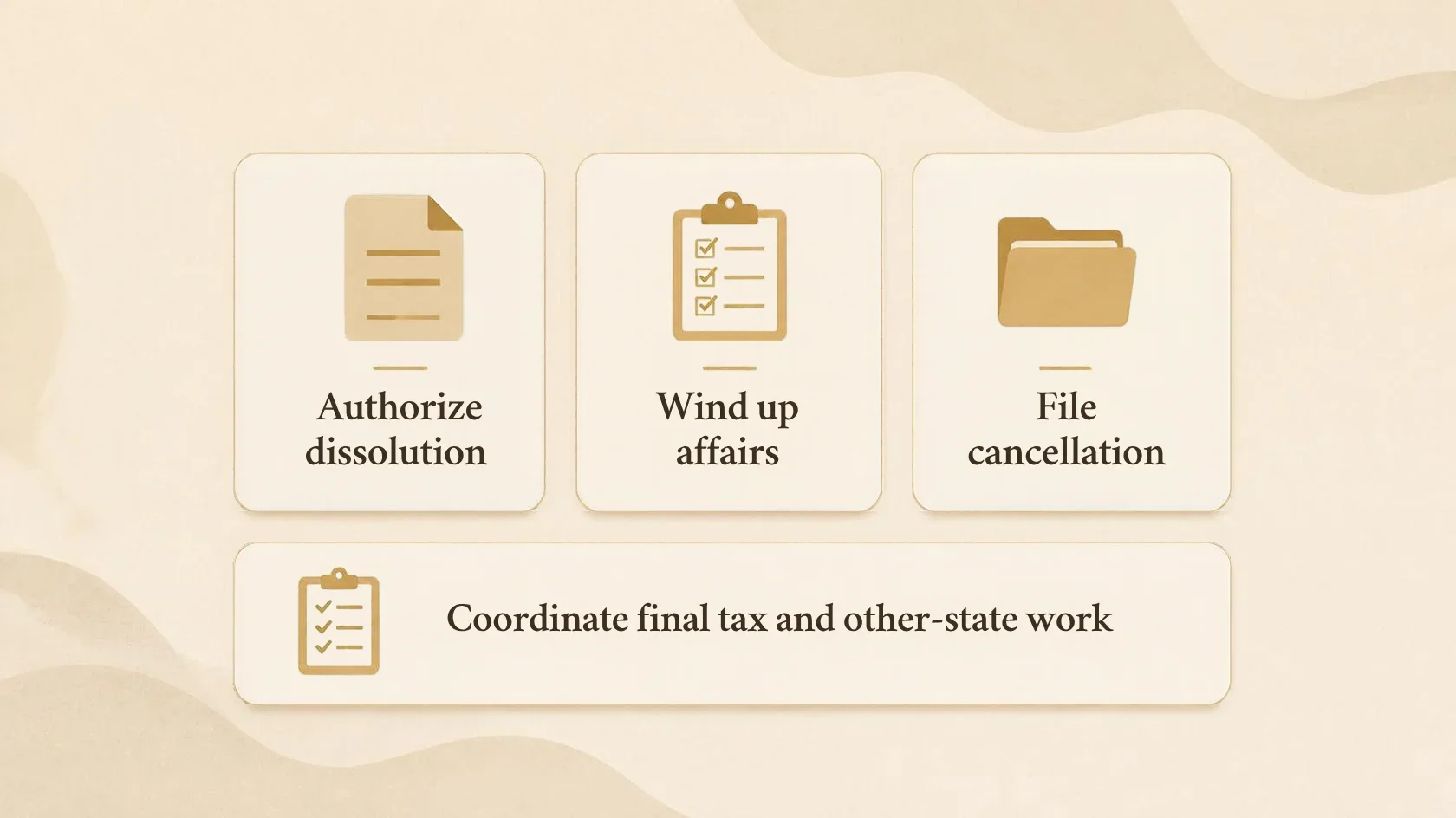
These terms describe related stages:
| Stage | Practical purpose |
|---|---|
| Dissolution | The event or authorized decision to end the business |
| Winding up | Resolving the company's remaining affairs, claims and property |
| Cancellation | Filing the state document that ends the certificate of formation after the required process |
| Final tax and account work | Completing obligations with the IRS and other relevant agencies |
Keep a written closure plan with a responsible person for each task. A short checklist is useful, but it should reflect the company's actual contracts and liabilities.
Step 1: document the authorization
Follow the operating agreement and applicable law. Record the approval, date and people authorized to act. A single-member LLC should also keep a clear written record rather than relying on an informal intention to stop.
If members disagree, a lawsuit is pending or the LLC cannot meet its debts, obtain legal advice before transferring assets or filing. A routine online cancellation guide cannot resolve those issues.
Step 2: wind up the business
Make an inventory of customer commitments, refunds, supplier balances, loans, employees, leases and subscriptions. Determine what must be completed, terminated or reserved for before money is distributed to owners.
Collect receivables and identify assets that will be sold or distributed. Keep accounting records of each transaction. Closing transactions can matter for tax reporting even if the business stopped making sales earlier.
Delaware's winding-up rules address creditors and provision for claims before distributions to members. Do not empty the bank account first and leave unresolved obligations without a plan. Delaware LLC Act, winding up and distribution rules.
Keep a working payment account available for necessary final expenses and refunds. Coordinate its eventual closure with the accountant and any person managing claims.
Step 3: confirm the Delaware tax balance
The Division of Corporations' current LLC guidance lists a $400 annual tax. Older articles may show $300, so use the current state instructions and the entity's actual balance. Ordinary annual payment is generally due June 1, but cancellation requires a separate balance review through the effective date. Delaware LLC tax instructions.
The current LLC tax statute should be read with the cancellation instructions. Ask the state or filing provider to identify the current-year tax, arrears and any late charges separately. Do not assume the tax is prorated because closure occurs partway through the year.
For a limited budgeting example, a $220 filing plus one unpaid $400 annual tax amount totals $620. This is not a universal cancellation price. Earlier balances, penalties, optional services and professional fees can change it.
Step 4: prepare the Certificate of Cancellation
Use the current domestic LLC form from the Division of Corporations dissolution and cancellation resources. Confirm the legal name, original formation date and authorized signer's details.
Select any effective-date provision carefully. A delay around year-end can affect obligations, so resolve the intended timing with the tax balance and winding-up plan before submitting.
Follow the current cover-sheet, payment and submission instructions. Optional certified copies or expedited service cost extra. Buy them only if they serve a specific need, and avoid promising a completion date before acceptance.
Step 5: keep the accepted document
Save the filed cancellation and confirmation of its effective date. Check that the state record reflects the expected result. Keep the authorization, tax payments and supporting correspondence with it.
A provider's order confirmation proves that you requested assistance. The accepted state document is the evidence of the completed filing. Ask for both where you use a service.
Finish the federal and other-state work
The state filing does not submit final federal returns or close every tax account. The appropriate returns depend on tax classification, ownership and activity. Payroll and contractor reporting can require separate attention. IRS closing-a-business guidance.
A foreign-owned US disregarded entity should review Form 5472 obligations for its final reporting period. Contributions, distributions and other reportable transactions can matter. Do not assume cancellation makes those transactions disappear. IRS Form 5472 instructions.
The EIN remains the company's permanent federal identifier. The IRS has a process for closing the associated business account; this does not erase the EIN or unpaid obligations.
If the LLC was registered in other states, review each withdrawal and associated account closure separately. Keep someone available to receive correspondence after the commercial activity ends.
Ask for a closure scope you can verify
Contact PrimeRegister with the LLC's formation year, current state status and any additional state registrations. We can confirm the assistance available and what it includes.
Ask that government filing, outstanding taxes, private fees and final tax preparation be identified separately. That makes it easier to track the work through to completion.