Payments and Marketplaces
Merchant of Record vs Payment Processor for a US LLC
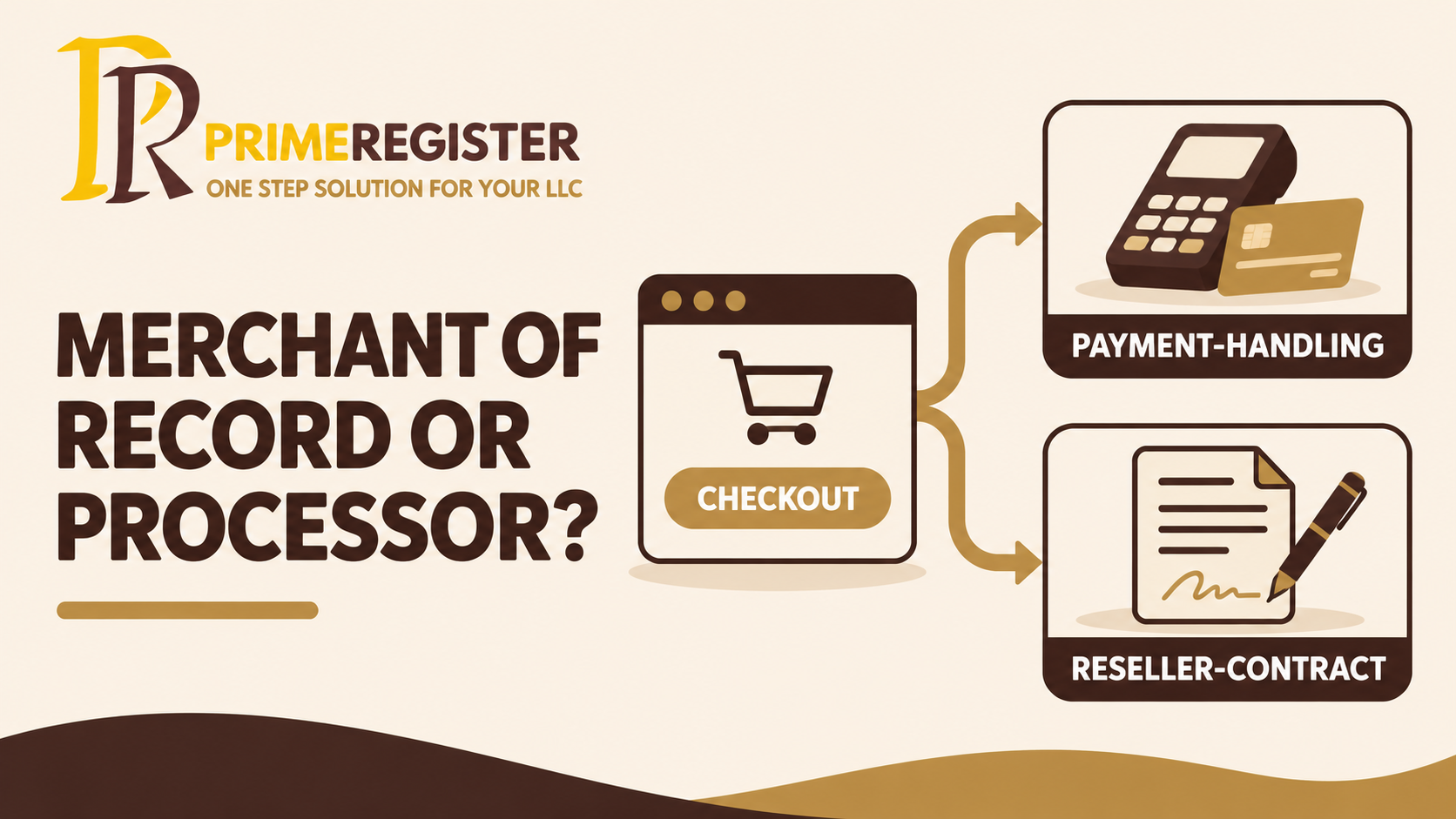
The merchant of record vs payment processor decision is about who takes responsibility for the customer transaction, not simply which checkout button you install. A processor generally supports payment handling for your sale. A merchant-of-record arrangement can place a provider in the reseller role for covered transactions, with responsibilities defined by its contract.
The merchant of record vs payment processor decision is about who takes responsibility for the customer transaction, not simply which checkout button you install. A processor generally supports payment handling for your sale. A merchant-of-record arrangement can place a provider in the reseller role for covered transactions, with responsibilities defined by its contract.
For a software founder with a US LLC, this can change the operational workload. It does not eliminate the need to understand the company's own accounts, tax filings or obligations outside the provider's scope.
Merchant of record vs payment processor: the central distinction
Paddle, for example, explains that it acts as a reseller and merchant of record, taking responsibility for relevant transaction VAT and sales-tax obligations within its service. That describes its model; it should not be assumed to describe every provider or every product. Paddle's merchant-of-record explanation.
Read the agreement to establish who sells to the customer, whose terms apply and which transactions are covered. Marketing labels are less useful than the actual allocation of responsibilities.
| Question | What to establish before choosing |
|---|---|
| Customer contract | Who is legally selling the covered product? |
| Indirect tax | Who determines, collects and remits it, and where? |
| Refunds | Who approves them and bears their cost? |
| Disputes | Who responds and what evidence must you provide? |
| Payouts | What deductions, reserves and timing rules apply? |
| Exit | Can customer data and subscriptions move to another provider? |
Start with the product, not the company state
Identify what you are selling
Software subscriptions, consulting engagements and physical merchandise can face different platform rules. Write a plain description of the product, delivery and customer base. Do not assume that approval for one product extends to another.
Identify the countries involved
Map the company, people and customer locations. A provider's willingness to serve your business is separate from the list of countries where it can manage particular customer transactions.
For a direct processor route, our Stripe guide for non-US residents explains the company and identity checks. Our LLC for SaaS guide covers the broader business setup.
Compare costs using your actual sales pattern
A headline percentage does not tell you the complete cost. Build a sample month using your likely order count, currencies, average sale, refunds and subscription changes. Include any fixed charges and services you would otherwise buy separately.
Do not invent a universal break-even revenue figure. A provider that is economical for low-volume international subscriptions may be less suitable for a different product or support model. Request current pricing and write down the assumptions behind the comparison.
Include the work you retain
Even with outsourced transaction handling, your team may still need to deliver the product, resolve technical complaints, maintain records and provide evidence. Ask what happens when a customer disputes whether the software worked. Outsourcing checkout does not automatically outsource product quality.
Keep transaction taxes separate from the LLC's tax affairs
Sales tax or VAT on a customer sale is a different subject from tax on business income or information returns involving foreign ownership. The label “tax handled” needs a scope.
The IRS treats LLCs according to ownership and elections; the payment arrangement does not choose that classification. IRS LLC guidance. Use our foreign-owned LLC tax checklist to identify questions that remain outside checkout.
Keep records of the actual contractual arrangement
For each reporting period, save sales or reseller statements, adjustments, fees and payouts. Give your accountant the agreement as well as the bank deposits. The correct accounting cannot always be inferred from a deposit description.
Imagine a developer comparing two offers: one processes the developer's customer charges; another resells the covered software. Both produce cash payouts, but the legal transaction and recordkeeping may differ. Ask the accountant to review that difference before integrating either provider.
Choose an arrangement you can operate consistently
Select the model after comparing eligibility, customer experience, contractual scope, cost and exit options. If the business also needs a US entity, contact PrimeRegister about formation. Keep provider approval and professional tax review as separate decisions rather than expecting the LLC filing to resolve them.
Research checked 7 November 2026. General information, not individual legal or tax advice. Check current official requirements before acting.