LLC Taxes
Texas LLC Tax Filing Requirements: Franchise Tax and PIR
Separate the Texas franchise tax threshold from the Public Information Report and other filings an LLC may still need.
Texas LLC tax filing requirements depend on the company's revenue, tax classification and activities. An ordinary LLC can owe no Texas franchise tax and still have an annual Public Information Report, or PIR, to submit.
For the 2026 and 2027 report years, the franchise tax no-tax-due threshold is $2,650,000 of annualized total revenue. It is not a net-profit threshold. Being below it also does not remove federal tax filings or every other Texas tax obligation. Texas Comptroller franchise tax guidance.
Checked 7 October 2026. This guide addresses ordinary LLCs; special exemptions, combined groups and unusual structures need a separate review.
Texas LLC tax filing requirements at a glance
| Requirement | What an ordinary LLC should check |
|---|---|
| Texas franchise tax | Revenue threshold, report year, margin and applicable exceptions |
| Public Information Report | Generally required annually for an LLC, even below the no-tax-due threshold |
| Federal returns | Depend on classification, owners and transactions |
| Sales and use tax | Depends on taxable sales, nexus and permit requirements |
| Employment obligations | Depend on workers and applicable payroll or unemployment rules |
| Other state registrations | May create separate obligations outside Texas |
Start by identifying the correct report year. Do not use an old threshold or an old No Tax Due Report simply because it appears in a saved checklist.
What changed about the No Tax Due Report?
For reports due on or after January 1, 2024, an entity at or below the applicable annualized-revenue threshold generally does not file the old No Tax Due Report. It still needs the applicable information report unless a specific exception applies.
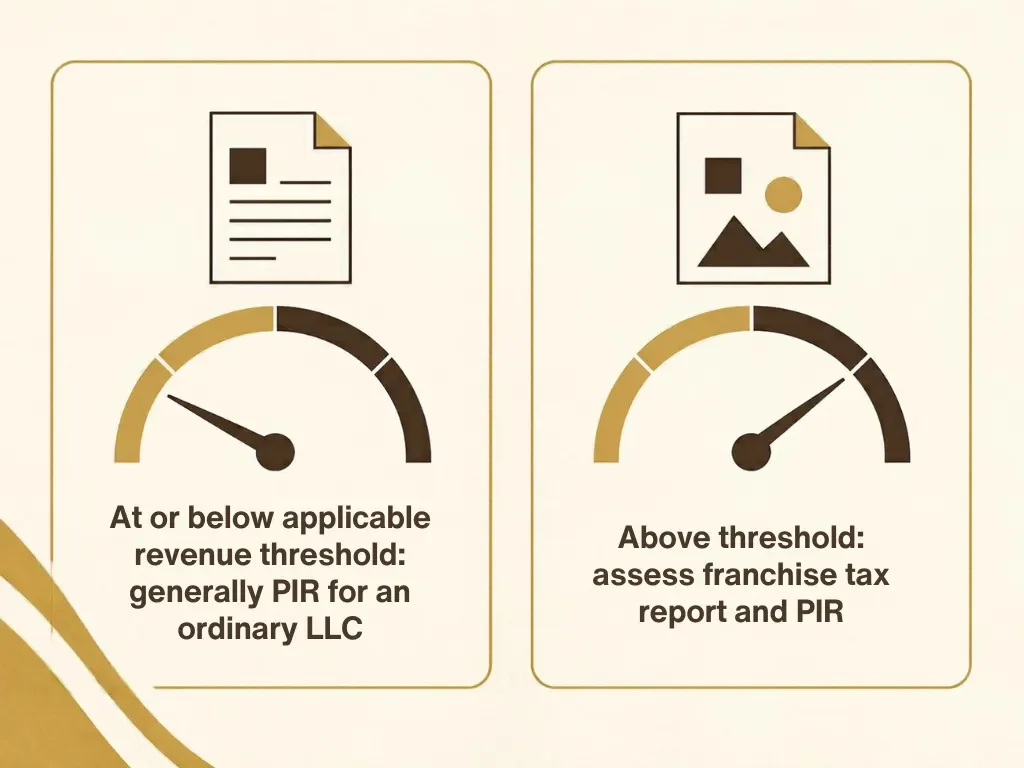
The Comptroller's 2026 franchise tax forms page expressly says the No Tax Due Report is not available for that report year. For an ordinary LLC, the relevant information filing is generally the PIR, Form 05-102.
Do not read “no tax due” as “nothing to submit.” These are different conclusions. A company can be below the tax threshold and still need to update the government's management and ownership information.
PIR or OIR: which one applies to an LLC?
The Comptroller distinguishes the Public Information Report from the Ownership Information Report, or OIR. Ordinary LLCs fall within the PIR group. Other entity types can use the OIR.
Review the correct fields for the company's management structure rather than copying a corporation's officer list. The official instructions explain the information required for managers, members and ownership relationships. PIR and OIR guidance.
Keep the report accurate as of filing. An unchanged business can still have a reporting obligation; the absence of changes does not mean the form is unnecessary.
When is the annual deadline?
The ordinary annual franchise tax and information-report deadline is May 15. When it falls on a weekend or legal holiday, the Comptroller applies the next-business-day rule. Check the relevant report year's instructions and the company's account for its first required report or any special circumstances.
As of this guide's October 2026 research date, the ordinary May 2026 deadline has passed. A company reviewing 2026 compliance now should confirm whether its required report was already filed, rather than treating the next May as the deadline for everything outstanding.
If a report is missing, review the current account and any notice before submitting. A late report can produce a $50 penalty even when no franchise tax is due. Unresolved compliance can also affect the company's state status. Comptroller franchise tax guidance.
How the revenue threshold works
Use the Comptroller's definition of annualized total revenue, not the cash left in the bank or the owner's take-home income. Short accounting periods can require annualization, which means a partial year's receipts cannot always be compared directly with the full-year threshold.
For a simple illustration, an ordinary LLC with $300,000 of qualifying annualized total revenue is below the 2026 threshold. That fact may remove the franchise tax report requirement associated with exceeding the threshold, but it does not normally remove the PIR.
If revenue exceeds the threshold, review the appropriate EZ Computation or long-form report and the tax calculation. Do not multiply all sales by a tax rate without examining margin, apportionment and eligibility. Current reporting changes.
Prepare before using Webfile
Gather the following:
- The Texas taxpayer number and relevant Webfile access information.
- The legal name and Secretary of State record, where applicable.
- The correct report year and accounting-period information.
- Revenue records needed to determine the reporting route.
- Current managers, members and ownership details required for the PIR.
- Previous confirmations and any outstanding notices.
Use the official Comptroller service and its current report instructions. The Texas taxpayer identifier and access code are different from the federal EIN. Keep credentials private and give access only through an appropriate secure arrangement.
After submission, save the confirmation and a copy of the completed report. Check any separate payment step rather than assuming that submitting information automatically paid a balance.
Federal tax obligations are separate
An LLC's state-law form does not by itself determine its federal tax return. A single-member disregarded entity, partnership and LLC with a corporate election can have different filing requirements. Review the IRS LLC guidance for the classification framework.
International ownership adds questions about the owner's status and reportable transactions. A foreign-owned US disregarded entity may need Form 5472 with a pro forma Form 1120. Texas's no-tax-due threshold does not create an exemption from that federal reporting. IRS Form 5472 instructions.
Keep state and federal confirmation files separate. That makes it easier to see whether a preparer's quoted service included both systems or only one.
Check sales tax and employment separately
If the LLC sells taxable goods or services, review Texas sales and use tax registration and filing rules. A franchise tax result does not determine whether a sales tax permit is required. Texas sales tax guidance.
If the company hires workers, review federal payroll duties and Texas unemployment requirements. Worker classification and the location of work matter. Texas Workforce Commission employer tax guidance.
Do not assume a business is exempt from these checks because its owner lives outside the United States. Build the obligations from the company's actual operations.
Get a clear filing scope
Contact PrimeRegister with the report year, ownership structure and whether the LLC has revenue, employees or taxable sales. We can discuss available assistance and confirm the work included.
Ask whether the quote covers the PIR, any franchise tax computation and federal or other state returns. That distinction is more useful than a general promise to “renew the LLC.”