Tax and Compliance
Filed Taxes but Got a $25,000 Form 5472 Penalty?
A filed tax return does not always satisfy Form 5472 reporting. Learn why a foreign-owned LLC can face a $25,000 penalty, what evidence to check and how to approach an IRS notice.

You filed your tax return. You paid what you believed you owed. Then an IRS notice arrived showing a $25,000 Form 5472 penalty.
How can both things be true? Filing an income tax return and meeting an international information-reporting requirement are separate obligations. A required Form 5472 may have been missing, late or substantially incomplete even though another return was submitted. The IRS also penalizes certain failures to maintain the required records. IRS international penalty guidance.
This issue is particularly relevant to foreign-owned US single-member LLCs treated as disregarded entities. It does not mean every LLC, every foreign owner or every tax mistake triggers this penalty. The first question is what your notice actually says was missing or incorrect.
Why a Form 5472 penalty can apply after you filed taxes
“My taxes were filed” is a starting point, not a complete filing record. Identify the taxpayer, form, tax year, attachments and submission evidence.
| What you completed | What still needs checking |
|---|---|
| The owner's personal income tax return | Whether the LLC had its own information-reporting requirement |
| A state annual report or state tax payment | Whether the separate federal reporting was completed |
| A federal corporate return | Whether all required Form 5472 filings and statements accompanied it |
| A return prepared before the deadline | Whether the complete package was actually submitted on time |
| A return submitted after the deadline | Whether it was late despite being filed eventually |
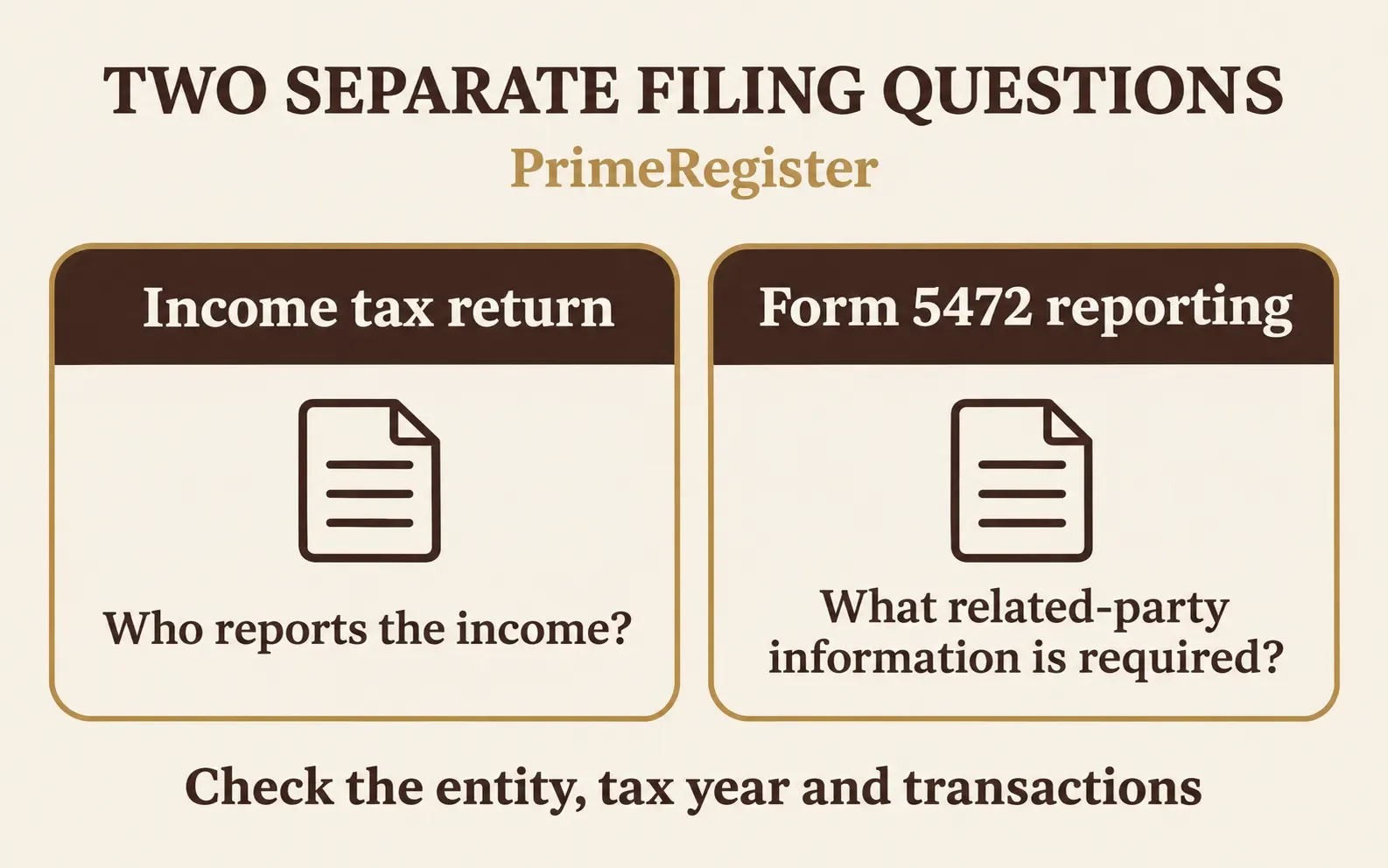
The IRS describes late filing, missing required information and recordkeeping failures as separate reasons to examine Form 5472 compliance. A later submission does not automatically erase an earlier failure. IRS Form 5472 penalty procedures.
Before assuming the notice is correct—or assuming it must be wrong—compare it with the actual submitted package. A preparer's invoice or a portal status reading “completed” does not show which attachments the IRS received.
Which foreign-owned LLCs need this review?
A US LLC with one foreign owner that is disregarded for federal income tax purposes can be treated as a reporting corporation for these limited reporting rules. Reportable transactions and the applicable exceptions must be assessed. Some 25% foreign-owned US corporations and foreign corporations engaged in a US trade or business also fall within Form 5472's scope. IRS Form 5472 instructions.
Do not apply the single-member disregarded-entity workflow to every multi-member LLC. Start with the company's actual LLC tax classification. Ownership, accepted elections and the tax period matter more than the label on a formation package.
Your existing Form 5472 and pro forma Form 1120 guide explains the filing framework. This article addresses the different question: why a penalty can appear despite believing the tax work was finished.
No revenue does not always mean no reportable transaction
For a foreign-owned US disregarded entity, reportable transactions can include owner contributions, distributions and amounts connected with formation or dissolution. Reporting is not limited to sales to customers. Treasury reporting regulation, section 1.6038A-2.
Hypothetical example: A foreign individual owns a US single-member LLC with disregarded treatment. The owner transfers $5,000 into the business, which makes no sales that year. A preparer files the owner's separately required personal return, but the LLC's reporting is not reviewed.
The personal filing does not substitute for reporting the LLC-owner transaction where required. The $5,000 contribution should have been identified and assessed, despite zero customer revenue. Whether a penalty is appropriate depends on the complete facts and filings; this example is not an actual client case.
Prepare a transaction list covering money put into the company, money taken out, loans and expenses paid on its behalf. Keep each transaction's date, amount, parties and supporting record. Our owner contributions versus loans guide explains why those categories should not be mixed together.
Check the filing package, deadline and delivery method
For a foreign-owned US disregarded entity required to file, Form 5472 is attached to a pro forma Form 1120. The current IRS instructions provide a dedicated submission process and state that these entities cannot file Form 5472 electronically. Do not assume an electronic acknowledgment for another return proves this package was filed. IRS filing instructions.
Ask for the complete filed copy, including all attachments, and evidence of the route used. Compare the entity name, EIN, tax period and related-party information across the documents. If there was a rejection or failed transmission, preserve that record too.
An extension also needs its own evidence. The applicable Form 7004 must generally be filed by the original due date, and the special foreign-owned disregarded-entity instructions must be followed. An owner's personal extension should not be assumed to cover the LLC's package. IRS Form 7004 instructions.
See the Form 7004 extension guide for the preparation questions. A calendar reminder that says “extension done” is less useful than the actual form and submission confirmation.
Can the penalty exceed $25,000?
Yes. Under the regulation, failures can be considered by related party and taxable year. If a failure continues beyond 90 days after IRS notification, additional $25,000 penalties can apply for each subsequent 30-day period or part of a period, under the continuation rules. The initial amount is not a universal cap. Treasury penalty regulation.
Do not interpret that 90-day rule as permission to ignore the response deadline printed on your notice. It describes a continuation-penalty rule, not a replacement deadline for every notice or appeal.
What to do when the IRS notice arrives
1. Identify the issue and response date
Read the notice number, taxpayer name, EIN, tax period, stated reason and response instructions. Follow the actual notice rather than a generic deadline from an online article. The IRS advises taxpayers to read notices carefully and respond by the stated date when a response is needed. Understanding an IRS notice.
2. Assemble one complete evidence folder
Include:
- The notice and any earlier correspondence.
- The complete return package and required statements.
- Submission, delivery or transmission evidence.
- Any extension and evidence of its submission.
- Ownership and classification records.
- Related-party transaction records and the preparer's engagement letter.
Write a dated timeline of what happened. Distinguish what someone remembers from what the documents establish. For example, “sent documents to the preparer” and “preparer submitted the return” are two different events.
3. Have the filing and notice reviewed together
Use a CPA, enrolled agent or tax attorney experienced with foreign-owned entity reporting and international information-return penalties. The review should identify whether the requirement applied, whether the IRS has the correct facts, what correction is needed and how to preserve the available response or appeal rights.
Avoid sending repeated, inconsistent copies without a coordinated response. Ask which address or method applies to the notice response and which applies to any corrective filing; they may serve different purposes.
4. Assess relief without assuming it is automatic
Reasonable-cause relief may be available, but it is fact-specific. The regulation requires an affirmative factual showing in a written statement with a penalties-of-perjury declaration. Professional involvement alone does not automatically establish reasonable cause. Reasonable-cause rules.
Keep the explanation truthful and supported by records. Do not invent an illness, missing letter, technical failure or advice that was never given. A qualified representative can help distinguish disputing an incorrect assessment from seeking relief for an actual filing failure.
How to make next year's filing easier to verify
Replace the question “Did you file my taxes?” with a specific handoff checklist:
| Ask the preparer | Keep this evidence |
|---|---|
| Which entity and tax year did you review? | Written scope and classification record |
| Which forms and statements were required? | Final filing checklist |
| Were owner and related-party transactions reviewed? | Reconciled transaction schedule |
| Was an extension needed and submitted? | Extension copy and submission evidence |
| How was the complete package filed? | Filed copy and delivery or transmission record |
| Who monitors subsequent IRS correspondence? | Named contact and access to the notice address |
Maintain the records during the year rather than reconstructing every transfer at the deadline. The foreign-owned LLC bookkeeping guide provides a practical starting point.
The important distinction is simple: proof that a return was filed is not proof that every required filing was complete and timely. Verify the scope, attachments and evidence together.
If you already have a penalty notice, prioritize qualified tax representation. For a new LLC, contact PrimeRegister to discuss formation support and clarify which ongoing services are included before ordering. Formation assistance should not be mistaken for an agreement to prepare international tax filings or handle penalty disputes.
General educational information, checked 5 November 2026. Filing requirements and penalty relief depend on the entity, transactions, tax year and notice.