Tax and Compliance
W-8BEN vs W-9 for Foreign-Owned LLCs: Key Differences
W-8BEN vs W-9 is not decided simply by whether your LLC was formed in the United States. The correct documentation depends on the payee's tax status, the entity's classification, the beneficial owner and the type of payment.
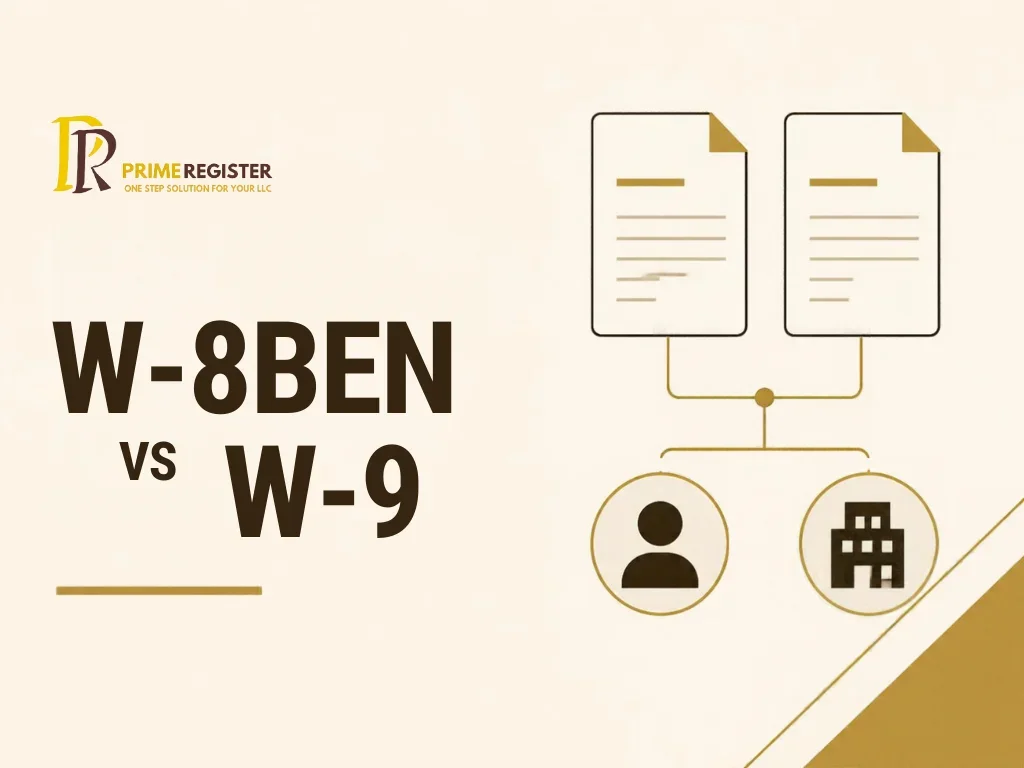
W-8BEN vs W-9 is not decided simply by whether your LLC was formed in the United States. The correct documentation depends on the payee's tax status, the entity's classification, the beneficial owner and the type of payment.
For a foreign-owned single-member LLC that is disregarded for federal income tax purposes, the owner's status can be central. Do not sign a US-person certification merely because the company has an EIN.
W-8BEN vs W-9: identify whose status is being documented
| Starting situation | Documentation to assess |
|---|---|
| Foreign individual beneficial owner | Often W-8BEN, subject to the payment and applicable rules |
| Foreign entity beneficial owner | Often W-8BEN-E, not the individual form |
| US person | Generally W-9 for the relevant certification |
| Effectively connected income | Assess W-8ECI rather than assuming W-8BEN |
| Intermediary or special arrangement | Other documentation may apply |
This table is a starting point, not a complete form-selection decision. The IRS W-8BEN instructions explain who uses the form and when another form is required.
Why a disregarded LLC creates confusion
The LLC exists under state law, signs contracts and may hold a bank account. Federal tax documentation can nevertheless look through a disregarded entity to its owner for specified purposes.
The IRS instructions explain that a foreign individual who is the single owner of a disregarded entity generally provides the owner's information on W-8BEN in the described circumstances. The entity/account connection can be identified using the relevant reference information.
That does not mean every foreign-owned LLC uses W-8BEN. A corporate election, partnership classification, foreign corporate owner or different payment type can change the analysis. The IRS requester instructions address these broader documentation rules.
Gather the facts before choosing a form
Record the LLC's owners, tax classification, any elections and the nature of the income. Identify the payer and what the form request is intended to document.
Ask whether you are documenting the company, its owner, an intermediary relationship or a particular income category. Keep the ownership chart and classification evidence available if the payer asks why the form differs from a standard US-company template.
A customer-support instruction to “enter your EIN” is not a tax analysis. The correct taxpayer-identification field depends on the form and the relevant person.
Review ITIN vs EIN if a request for a taxpayer number is creating confusion about which person the form identifies.
Handle a platform that offers only W-9
Do not certify information you know is inaccurate. Ask the platform's tax-documentation team how it handles your actual ownership and classification.
Provide a concise factual explanation and request the supported process. If the platform cannot accommodate the business's status, that may be an eligibility issue rather than something solved by selecting a different checkbox.
Keep the response with your records and involve a qualified tax adviser where the payment or classification is unclear.
The business account guide for non-residents explains the broader eligibility and documentation checks involved in financial onboarding.
Treaty benefits require a separate assessment
Foreign status does not automatically mean a treaty applies or that withholding is zero. Residence, beneficial ownership, income type and treaty-specific conditions matter.
Do not copy another founder's treaty article, rate or certification. A business operating from a different country may have a different result even if both companies were formed in the same US state.
The IRS Publication 515 provides the broader withholding framework for nonresident aliens and foreign entities.
Keep documentation current
Give the form to the requesting payer or institution as instructed; it is not generally a routine annual return mailed to the IRS. Review the form's validity and change-of-circumstances rules, and update the recipient when relevant facts change.
Save the signed form, supporting analysis and submission confirmation. Accurate onboarding documentation should agree with how the income is later reported.
Contact PrimeRegister to discuss the scope of available filing support and whether specialist review is needed for your ownership, payment and classification facts.
Use the foreign-owned LLC bookkeeping workflow to retain payment records and supporting documents that agree with the submitted tax information.